
Angie Paola Güiza
First Post

Hello! My name is Angie Paola, I am form Colombia and I am 21 years old. Since I was a child I have liked helping people who were consided bad citizens because their bad behavior. So now, I am stuying the best career in the world: psychology, which is something I am really passionate about, as well as doing sport too.

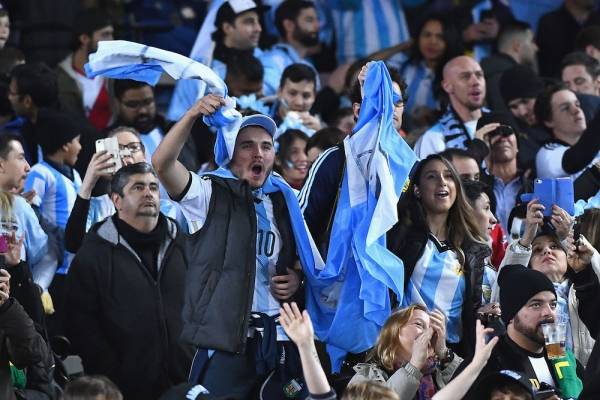
I would say that people from Argentina are happy and good sense of humor; they are very proud of their country and specially they are proud of their representative figures. For example, Leonel Messi, who is their favorite soccer player; and in the other hand there is The Pope Jorge Bergoglio. Also, I would say they all love and enjoy playing soccer.
In my view, they are extrovert people and a little vain. My view of them is base on their behavior when they come to Colombia for tourism; also on social media and memes.
Their official language is Spanish and their D. C is Buenos Aires.
Second Post: gender stereotypes
In this section we will talk about gender stereotypes in Argentina vs. Colombia.
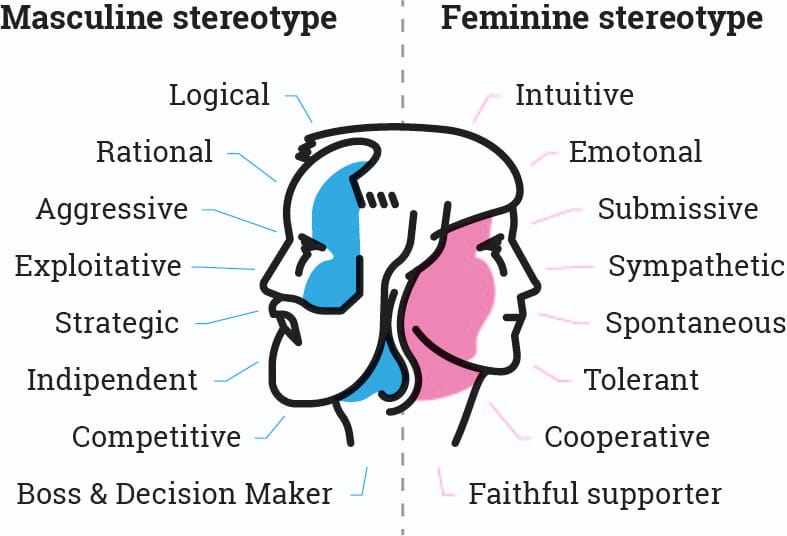

Colombia and Argentina are both Latin American countries thus, as they are in the same region, they share similar cultural aspects. In matters of gender stereotypes Colombia and Argentina are very similar. In both countries men are considered to be more independent and strong than women. The typical phrase “A women’s place is in the kitchen” sounds around these countries. This can be supported by the fact of, at large, in both cultures the political and monetary power is on men’s charge while women’s strengths are caring about children, cleaning hoses, being beautiful and so on. As far as I am concerned, these similarities are due to the fact that both countries are catholic, which makes them conservative and traditional.
Third Post: comparation between Argentinian vs. Colombian cultures based on Hofstede model
The Hofstede model is a theory that uses five dimensions to examine how a society’s values are affected by its own culture and the effects of this on a culture’s behavior. The five dimensions used are as follows:
- Power Distance
- Individualism
- Masculinity
- Uncertainty avoidance
- Long term orientation
- Indulgence
This comprarition will be supported by the information found on the page Hofstede Insights and the following graphic, which was also taken from the web page.
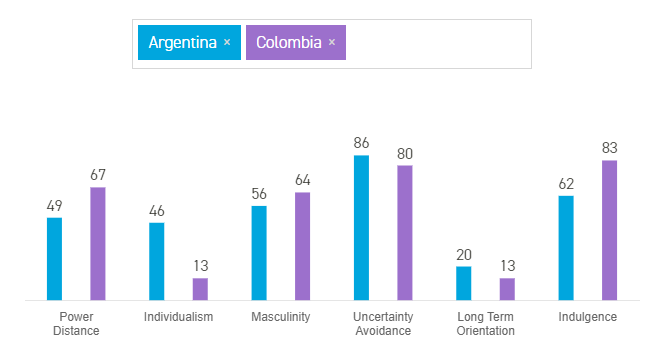
- Power distance: as we can see on the graphic above, Colombia points a higher value in this dimension than Argentina, which means that Colombian people do not ask justification for inequalities among them and accept these inequalities as fact of life. In the other hand, Argentinians demand equality among its society members ad complain when power is distributed unequaly.
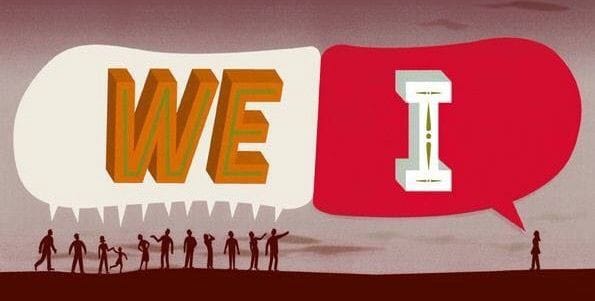
- Individualism: defined as “the degree of interdependence a society maintains among its members”. In this case Colombian cultures is considered to be a collectivism culture in which its members take care about each other in exchange for loyalty. The often work together to achieve a collective goal. But Argentinian culture is a more individual culture where its members are more independent and only care about their directs families.
- Masculinity: in this dimension the matter is the values that are considered more important for a society and how this affects its behavior. Well, Colombia’s and Argentina’s score are very similar, which means that in both cultures masculine values such as, competition, achievement ans success are dominant. So, these cultures are highly success oriented and driven.

- Uncertainty avoidance: a high score of 86 and 80 for Argentina and Colombia, respectively, means that in both cultures its member feel threthended by ambiguty so they have created beliefs and institutions to avoid uncertainty. Also, they both are corservative and traditional culures.
- Long term orientation: with a low score both societies are classified as normative cultures. They like keeping its links with their past and this is exhibit on their tradition. For example, in Colombia specially in the Caribbean cost the Carnaval de Barranquilla have been celebrated since 1918 showing that people from there like keeping their traditions and beliefs.
- Indulgence: indulgence counties exhibit high score in this dimension and this is the case of Colombia and Argentina, with a little discrepancy of course but yet similar. A high score means that people put a great importance on having fun and leisure time; they tend to realise their impulses and emotions regard enjoying life.
Four Post: Lewis Model
In this post we’ll talk about how Argentina is classified with respect to the Lewis model. This model divides the different cultures into three large dimensions, which are 1. Linear active, 2. Multi active and 3. Reactive culture. By means of this model and its three dimensions, Argentina can be categorized among the countries that have an Multi- active culture. Because most people in Argentina have qualities like: Talking and outgoing people, who can do several tasks at the same time. In addition, they are flexible, people who adapt to the moment and situations easily and they are good at persuading other people. Finally, Argentines have a good sense of humor and leave no conversations unfinished.
Considering that Argentinians are classified as a multi-active culture. If they would travel to Barranquilla-Colombia, a filmmaker studies would easily adapt to culture because people from Barranquilla are also categorized as multi-active culture. So, this intercultural relationship would not create serious problems, making even easy employees adapt better to the caribbean people.
Final Post: Subcultures in Argentina
In this last post we will talk about subcultures in Argentina, specifically about three: Maradonismo, Menonitas and sport duck.
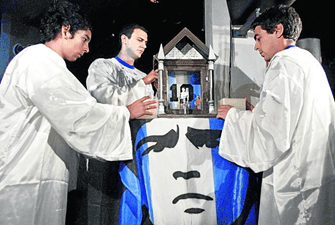
Maradonismo: is a group of followers and fans of Diego Maradona, who during the 80’s was cosidered the most important soccer player in Argentina. Nowadays Maradonists cosider Maradona as the best soccer player of all times. They created a modern religion and founded a Maradonian church at Rosario, Argentina with headquarters in Spain, Brazil and the United States. In their religion, they also have their own bible call <I am the people’s Diego>.
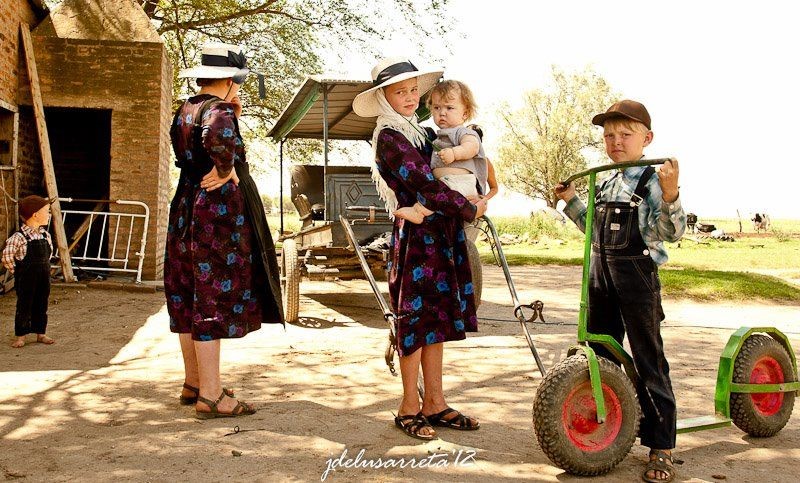
Menonitas: Menonitas are a group of about 1,400 people living in Argentina. They work in the land producing cheese, milk and vegetables. They also live without electricity, cars, telephony, television, or other developments of modern life. His dress is simple and his religious beliefs are Christian.

Sport duck: It is a sport from Argentina that is practiced by many Argentines. This sport is played by creating two teams of four people riding a horse and a leather ball with which they score points in a hoop. In the passage for the practice of this sport, no ball was used but a duck inside a bag.

 ARGENTINA